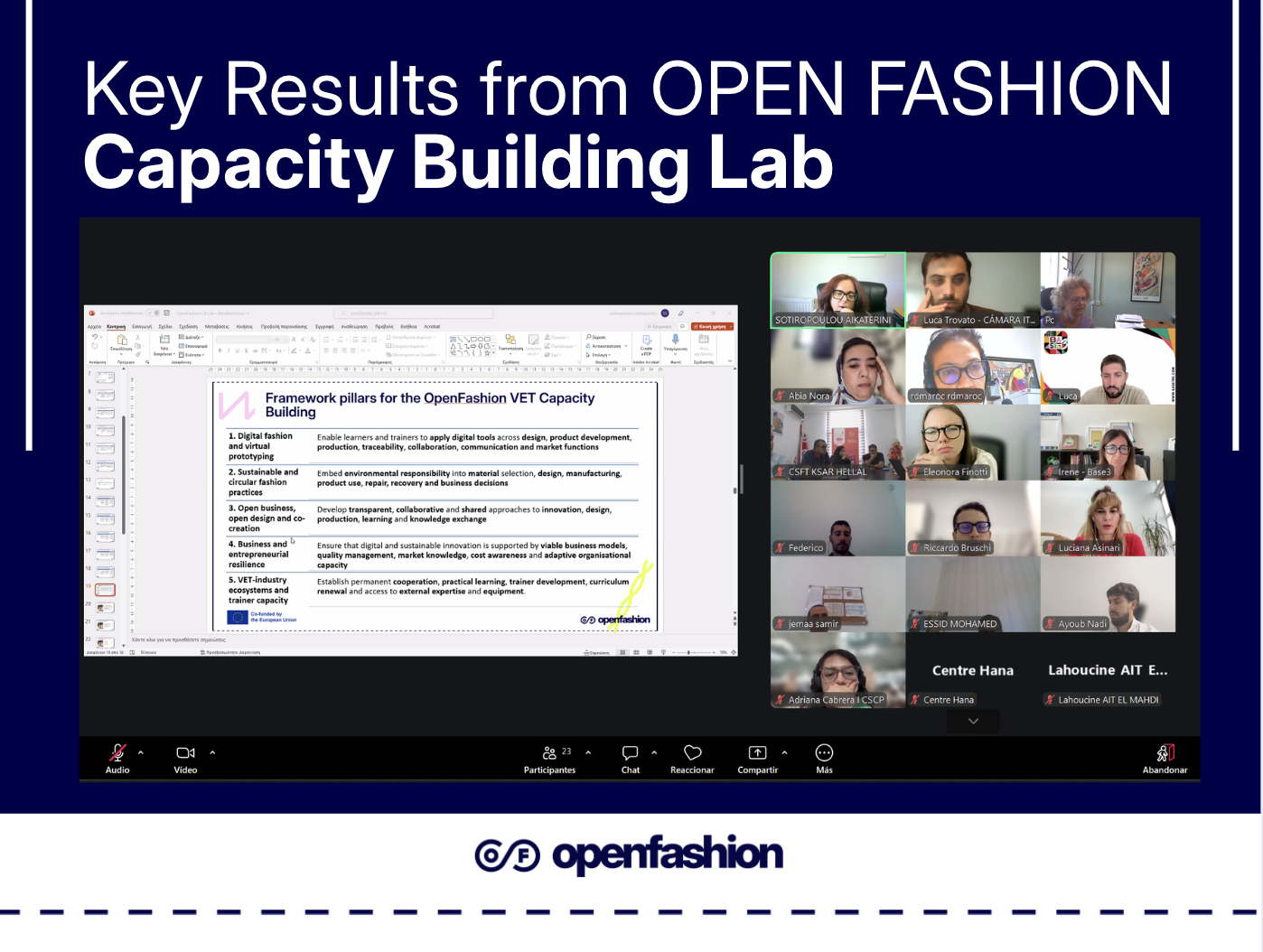
On 1 October 2026, an online Capacity Building Lab was held within the OPEN FASHION project, with the participation of project partners, experts and vocational education and training (VET) trainers. Coordinated by the Laboratory of Social Entrepreneurship and Social Innovation of the University of Patras (UPSESIL), the two-hour event took place via Zoom, bringing together 25 participants to discuss vocational training needs in the fashion sector, with active contributions from partners in Morocco and Tunisia.
The Lab opened with a presentation of the research findings on vocational training needs in the two countries. These findings provided the basis for discussing five proposed learning areas: digital fashion and virtual prototyping, sustainable and circular fashion, open business and open design, business and entrepreneurial resilience, and collaboration.
Partners shared their views on the proposed areas and suggested additional topics based on their experience in vocational education and their work with the fashion industry. A key point throughout the discussion was the need for practical vocational training that trainers can adapt to their learners and local conditions.
Participants recommended flexible modules, hands-on activities and examples from production and business practice. Specific suggestions included digital marketing, Life Cycle Assessment (LCA), waste management, sustainable manufacturing, product circularity, social responsibility and governance. Partners also stressed the need to keep vocational training materials up to date with technological developments and changes in the sector.
The discussion then focused on cooperation between VET institutions and businesses. Participants explored opportunities for joint activities, practical learning and shared access to equipment, particularly where advanced technologies are too costly for individual institutions or small enterprises. They also discussed difficulties in involving industry, protecting intellectual property and building trust. Existing institutional workshops and internship programmes were presented as useful starting points for connecting vocational education with industry needs.
Partners also contributed suggestions for the planned Moodle-based learning platform and the materials that will support trainers. They highlighted the value of interactive exercises, discussion forums, opportunities for questions and exchange, and resources that can be used in practical teaching. Certification and skills validation were also discussed, including micro-credentials. Participants shared experiences of how certification can motivate learners and raised the question of recognition within national education and training systems.
The Lab collected concrete proposals for the development of the OPEN FASHION vocational training toolkit and learning resources. Contributions from Morocco and Tunisia helped clarify local priorities and the conditions needed to put the proposed vocational training into practice.
The discussion outcomes will feed into the Guidelines, while a follow-up questionnaire will gather further feedback on vocational training modules, materials for trainers and skills validation.